
Transferring is one of the highest-stakes decisions in a student's academic life. They're not just looking for an open door; they need a guarantee that their past investment won't be erased. Yet the traditional admissions model asks them to apply, pay fees, and mentally commit before knowing two critical things: how many credits will count, and what they'll actually pay.
That's not just a recruitment hurdle. It's a retention crisis in disguise. Retention doesn't start on orientation day; it starts the moment a prospective transfer student first engages with your institution. If you want to protect your yield and secure long-term student success, you must realize that upfront cost and credit clarity is the ultimate transfer retention strategy.
The Hidden Cost of a "Blind Commitment"
The math behind the transfer journey is brutal but simple:
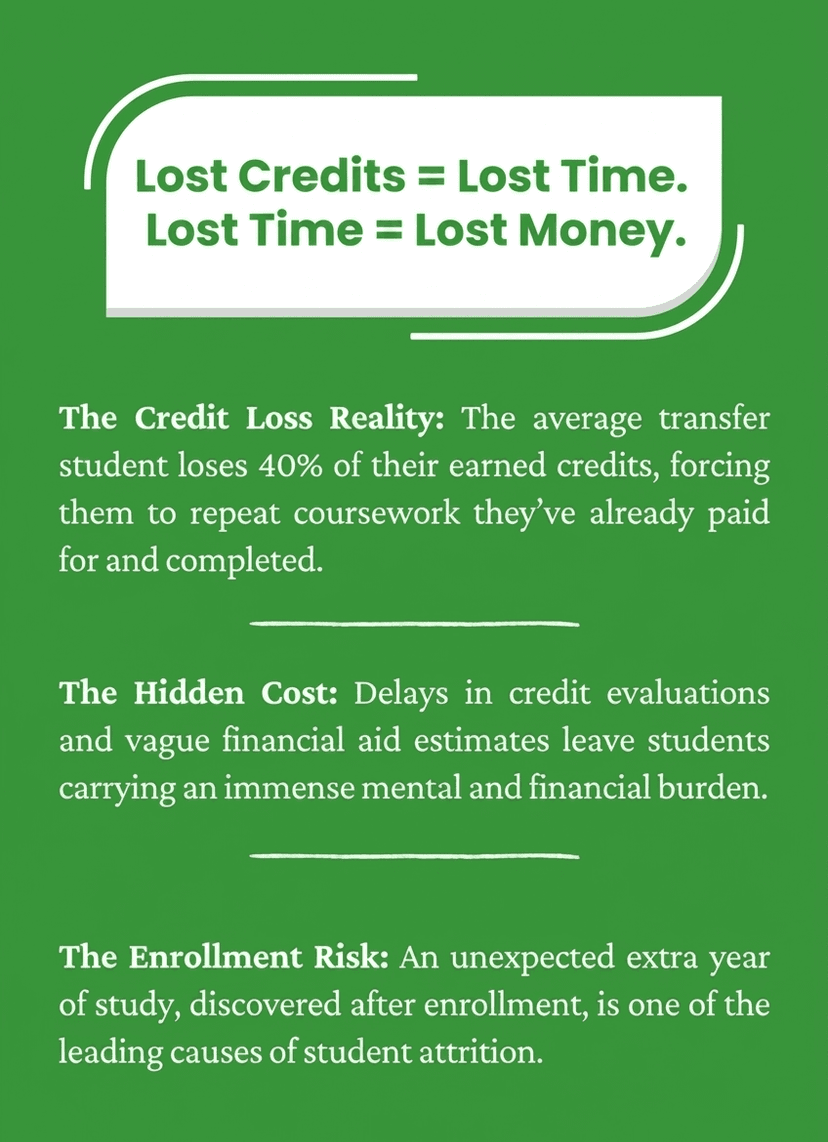
Lost credits = lost time. Lost time = lost money.
When an institution delays credit evaluation or gives a vague financial aid estimate, students carry a burden, both mentally and financially. According to a statistic, the average transfer student loses about 40% of their earned credits. It's thousands of dollars in repeated tuition, months of wasted effort, and a delayed start to their career.
When students enroll without clear answers, they're at high risk of dropping out after a semester once the real timeline and costs catch up with them. Imagine finding out three months into your first term that you now need an extra year of coursework you never planned or budgeted for. That kind of shock is exactly what pushes students to leave.
Cost Clarity: The First Domino
For transfer students, the main issue is uncertainty, not just cost. A transfer student is frequently making a mid-year decision, juggling work and existing coursework, and comparing multiple institutions in a compressed timeframe.
If your net price calculator gives a vague, generic estimate, or worse, one that doesn't account for transfer-specific aid, articulation agreements, or credit-based tuition adjustments; you've handed that student a reason to stall. And a stalled decision, in transfer admissions, is very often a lost one.
A net price calculator that reflects a student's actual transfer profile does more than generate a number. It signals competence. It tells the student: this institution has thought about someone exactly like you. That signal matters as much as the dollar figure itself.
Credit Clarity: The Second Domino
Cost gets a student to say yes. Credit evaluation determines whether they stay enrolled once they arrive. Nothing erodes trust faster than a transfer student discovering often after they've already committed that a course they assumed would satisfy a core requirement won't count, or that their credit evaluation is taking weeks longer than promised.
This is where manual, spreadsheet-driven transcript review becomes a genuine retention liability. Slow, inconsistent credit evaluations don't just frustrate registrars; they leave students in a decision vacuum at exactly the moment they're deciding whether this institution actually wants them. Every day of delay is a day a competing offer looks more attractive.
Automated, consistent transcript evaluation changes the emotional arc of the decision. A student who receives a clear, accurate credit evaluation within days rather than weeks experiences the institution as organized and responsive. That impression carries forward into their first semester and shapes how they interpret every future interaction with the registrar's office, financial aid, and academic advising.
Why These Two Have to Move Together
Cost and credit clarity are often owned by different offices, financial aid, and the registrar, which is exactly why they tend to arrive at different times, in different formats, with different levels of precision. From the student's perspective, though, they're one decision: can I afford this, and will my credits count?
When those two answers arrive close together, consistently, and tailored to the individual student, the results show operationally not just in enrollment numbers. Fewer melt losses. Fewer appeals. Fewer students hitting week three of the semester blindsided by a credit shortfall or a financial aid gap they didn't see coming.
Turning Clarity into a Retention Metric
Institutions doing this well don't treat cost and credit clarity as a nice-to-have for admissions. They treat it as core retention work. That looks like:
- Net price estimates built for transfer students, not generic first-year assumptions.
- Transcript evaluations turned around in days, not weeks.
- Credit decisions communicated proactively.
- Financial aid and registrar timelines working in sync, so students get the full picture at once, not half of it now and half of it later.
None of this requires convincing transfer students to care more about your institution. They already do, that's why they applied. It requires removing the two biggest sources of doubt before that doubt has time to calcify into a decision to go elsewhere.
Cost and credit clarity aren't just nice-to-have transparency measures. They're the retention strategy quietly doing the work long before a student ever sets foot on campus.
Closing the Gap
This is exactly the problem Virtue Analytics is working on. Our Net Price Calculator gives transfer applicants a real, personalized cost estimate, not a generic projection. VAST automates transcript evaluation, so credit decisions take days, not weeks.
Together, NPC and VAST answer both halves of a transfer student's biggest question about what I will pay and will my credits count?
For institutions, that means fewer students lost between acceptance and enrollment, fewer surprises after the semester starts, and a transfer experience that feels coordinated instead of improvised. It's not two separate tools bolted together; it's cost and credit clarity working as one system.